
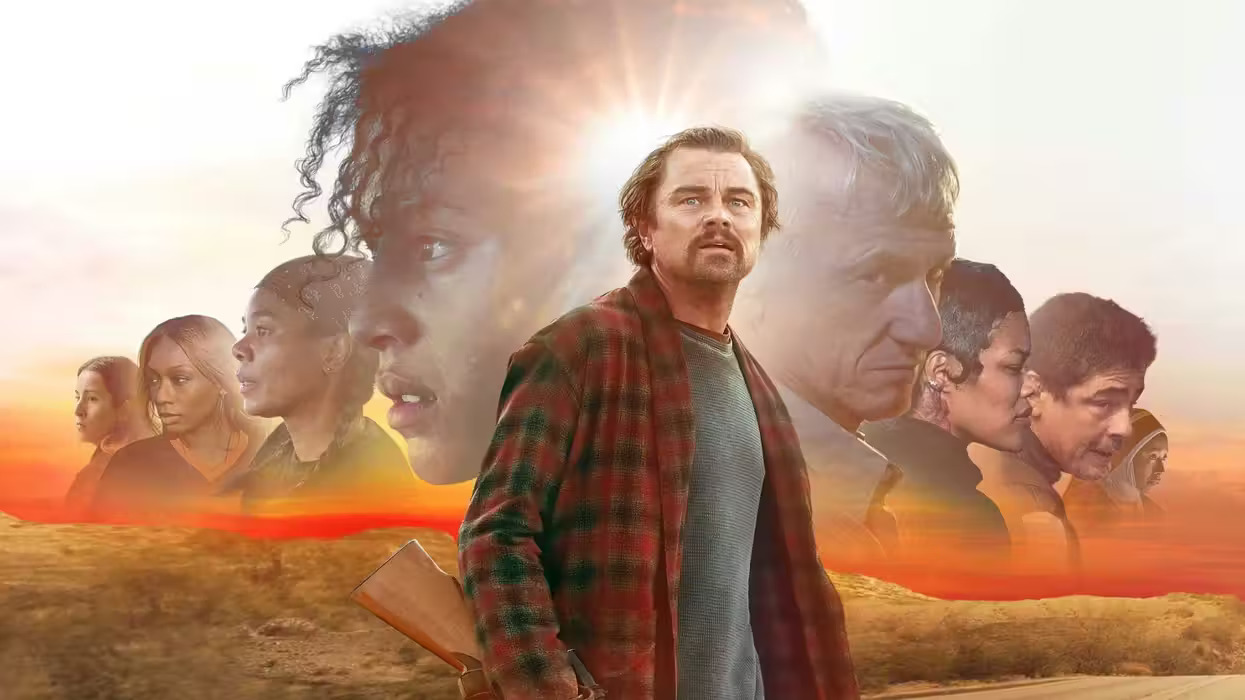
The movie that everyone will be talking about this year is Paul Thomas Anderson’s ‘One Battle After Another.’
The movie that everyone will be talking about this year is Paul Thomas Anderson’s One Battle After Another.
The movie is a sprawling, action-packed drama that blends a tale of radical activism, a covert government conspiracy, and a father’s desperate search for his daughter into one twisty tale that covers the entire state of California.
It ‘s a movie that has all the critics and fans debating its message and ending.
Today, I want to dig into the meaning of the movie and talk about why I think it’s a brilliant deconstruction of the American political system, and why you can sum it all up with the idea of choosing love.
The Plot Of ‘One Battle After Another’
The movie begins with a flashback to a group of radical activists known as the “French 75.” Among them are the charismatic and volatile Perfidia Beverly Hills (Teyana Taylor) and the more reserved explosives expert, “Ghetto” Pat Calhoun (Leonardo DiCaprio).
The group engages in various acts of protest and sabotage against what they perceive as a corrupt system, including freeing migrants, blowing up campaign offices, and robbing banks.
While this happens, they’re hunted by government agent Colonel Steven Lockjaw (Sean Penn), who becomes obsessed with Perfidia. She, in turn, likes his power and willingness to bend his rigid beliefs because he’s sexually aroused by her.
Perfidia and Lockjaw have sex after one of their operations without anyone else knowing about it.
This encounter has lasting consequences.
Perfidia has a baby, and lets Ghetto Pat believe he’s the father. But she has postpartum mixed with a feeling of maybe regret that she let her sworn enemy put a baby in her. She becomes distant and leaves the child behind.
Meanwhile, Lockjaw becomes obsessed with Perfidia, and a complex relationship develops between them. He knows she has had a kid and even confronts Pat about it.
Lockjaw is tasked with arresting her, and she’s supposed to hate him, but there is a strange attraction.
After Perfidia and the French 75 rob a bank, and Perfidia kills a security guard in cold blood, Lockjaw and his forces descend on their team and are able to capture them one by one.
Ultimately, Perfidia is apprehended and, to avoid a lengthy prison sentence, agrees to become an informant for Lockjaw, betraying her comrades in the French 75.
Her comrades are mostly killed, but a few of them get away, including Pat and her baby.
When Lockjaw tries to have a relationship with Perfidia, she escapes witness protection and disappears to Mexico.
The story then jumps forward sixteen years. Pat, now living under the name Bob Ferguson, is a paranoid, washed-up version of his former self, living off the grid with his and Perfidia’s teenage daughter, Willa (Chase Infiniti).
He has raised Willa in seclusion, attempting to shield her from the dangers of their past. However, their fragile peace is shattered when Lockjaw, who has risen through the ranks of a shadowy, white supremacist organization called the Christmas Adventurers’ Club, re-enters their lives.
To become a member of the racist organization, Lockjaw must prove he’s pure white. And for him, that means getting rid of the kid he had with a black woman all those years ago. So now he’s on the hunt for Pat and Willa in order to kill Willa, so there’s no evidence of what he perceives as his dark past left.
While at a school dance, the alarm from the French 75 sounds as Lockjaw tracks them down one by one to find Willa.
Willa is rescued from the dance by one of the members of the French 75 and taken to a nunnery, where they grow weed to hide out.
Lockjaw’s return coincides with Willa’s disappearance, and it propels Bob on a frantic and perilous journey to find her.
This quest forces him to reconnect with his revolutionary past and confront the consequences of his and Perfidia’s actions.
Willa’s karate sensei, who is also a coyote who helps needy immigrants across the border, free of charge, helps Bob escape the police and takes him to save Willa.
After escaping the city and heading to the country, he drops Bob off to get to the nunnery on foot to save his daughter as he distracts the police.
But Lockjaw is a step ahead and gets to the nunnery first.
Willa is captured by Lockjaw, who performs a DNA test confirming he is her biological father. To hide this “race-mixing” from his cult, Lockjaw gives Willa to a bounty hunter to be killed by a rogue team of mercenaries who guard the border.
The plot intensifies as the bounty hunter has a change of heart and dies while helping Willa escape.
Concurrently, the Christmas Adventurers’ Club discovers Lockjaw’s secret and turns on him. A member shoots Lockjaw on the road, and though he survives, the cult later executes him.
The Christmas Adventurers’ Club cult member then chases Willa down in a car to kill her, too.
Meanwhile, Bob steals a car and chases both of them, determined to save his daughter. Following a thrilling car chase, Willa kills the cult member who shot her father and is finally reunited with Bob, who gets there to help his daughter escape.
The Ending Of ‘One Battle After Another’
In the film’s closing moments, Bob gives Willa a letter from her mother, Perfidia, who expresses deep regret and a hope to reunite someday, even though she was a rat and abandoned them.
When Willia reads the letter, it provides closure for her and Bob as they move on respecting and trusting each other.
This emotional resolution is paired with a political one, as news of protests in Oakland inspires Willa to make the three-hour drive to join them. She decides to join the new movement, signifying that the revolutionary spirit of her parents has been passed down to a new generation, ready to continue the fight.
And Bob gets to lie on the couch and smoke weed and be proud that the fight continues on with the new generation.
What Does The Ending Of ‘One Battle After Another’ Mean?
I took this part straight from my Letterboxd. But I feel like it fully summarizes what I think I believe about this movie and what it means.
I like it when a movie challenges you, and this year, I’ve found several movies have asked us, elder millennials, what we believe. Not our performative beliefs, like putting black squares on our Instagrams or tweeting out our various virtue signals to make sure all our friends and randos know we’re on the correct side of history, but what are we willing to go to the streets for? What are we willing to go to jail for? Are we brave enough to be revolutionaries, and is being a revolutionary even good in the end? Are violent means to a just end on the left just the same horseshoe we see bending around the subjective morality on the right?
What if, in the end, both sides are bureaucratic nightmares rife with overreach?
Don’t be upset if you watch this movie and find out you’re a square. I left wondering if I had any edge left. Or maybe, on the verge of parenthood, all my sharper sides are pointed at anyone who would hurt my child.
Anyway, these are all timeless American questions.
This movie delivers on all those big questions in ways I’m not sure other filmmakers can even imagine. I understand why it took 20 years to make this movie, because I think this is an idea you have to have as a young man full of gusto, but it’s a story you may not be able to deliver on until you’ve seen some shit and raised a child.
What does our world look like, and is it a place you want to see someone grow up? And what do you want them to believe?
I guess you hope that they have a stake in what’s happening.
And you may be upset you weren’t able to change things for them.
But that might just be the circle of life.
The rawness of this story plays with your emotions. It rips into nature and nurture, it questions lineage and parentage, and even right and wrong in very messy ways. But the world is a mess, and there are no truly right or wrong stances if you’re making choices out of love.
The back half of this movie explores what happens when you let the loss of love blacken your heart. It might make you apathetic, or it may embitter you.
I found DiCaprio’s character to be a fascinating other side of the coin of Penn’s character—two jilted fathers looking for answers in a daughter who can’t give them to them. Two guys are afraid to give their daughter the answers she seeks, especially when they look at her and see her mother.
One father was literally sodomized by a gun, the other figuratively, when his wife executes an innocent security guard purely out of hate.
Leo’s arc is to go back to love; maybe it’s not about the wife anymore for him, but it’s about raising someone to be good, regardless of where she came from. Penn’s arc is to stay centered on hate. He was rejected, so he must stamp out all pain with evil. Again, simple but complex.
As I look back on my singular watch, I found Benicio Del Toro to be the moral center. He’s the only man with a pure code in the movie. That code is to help people and to train others to help them as well. He knows the odds are stacked against him, but he does what he does, and he’s able to do it well because he’s leading with love and not violence.
Regina Hall has the same heart, but the system takes her out for crimes in her past, accessory to murder, maybe more off-screen. But that system punishing her is corrupt, and yet so is senseless violence.
PTA does not make it easy on us. We have to parse out whether justice is ever served in this movie.
And how we feel about rats, abandonment, forgiveness, grudges, and society.
So, that brings me to the biggest question: whether or not, in the end, we feel like there’s hope for the world.
I think his answer is a resounding YES.
But the square in me saw Leo’s daughter running out the door to join in the revolution and wondered if she was a loaded gun away from making the same mistakes her Mom did. Not because she was her mother, but because there is no justice in this world, and therefore, there will never be peace.
And maybe that’s the point of the whole damn thing.
Summing It All Up
I thought this was a provocative movie that asked a lot of very hard questions of the audience. But it still was really funny and wore its heart on its sleeve at the same time.
It gave the audience a lot to unpack, and I hope you enjoyed unpacking it in a theater, so we get more films like this one.
Let me know what you think in the comments.